Architecture for intelligent systems that have to work in the real world.
We design AI and security architectures around the constraints that matter: probabilistic behaviour, authority, data, supply chains, operational burden, assurance and business value.

Five entry points into the same system.
Cloud Services
Choosing where AI workloads should run: MaaS, self-hosted inference, GPUs, CPUs, managed services and Kubernetes where justified.
Explore →Software Supply Chain
Curated libraries, containers, kernels and models; trusted sources, quarantine, rescanning, provenance and controlled promotion.
Explore →Compound / Agentic AI Systems
Deterministic mediation of secrets and security context, MCP/tool authority, prompt injection, RAG, tools and node-level controls.
Explore →Monitoring & Assurance
Semantic monitoring beyond latency: disagreement, instability, input novelty, subpopulations, shadow testing and assurance artefacts.
Explore →AI Security
Prompt injection, perceptual attacks, retrieval poisoning, leakage, extraction, model supply-chain risk and deterministic fail-closed controls.
Explore →Probabilistic systems need semantic monitoring, not just operational monitoring.
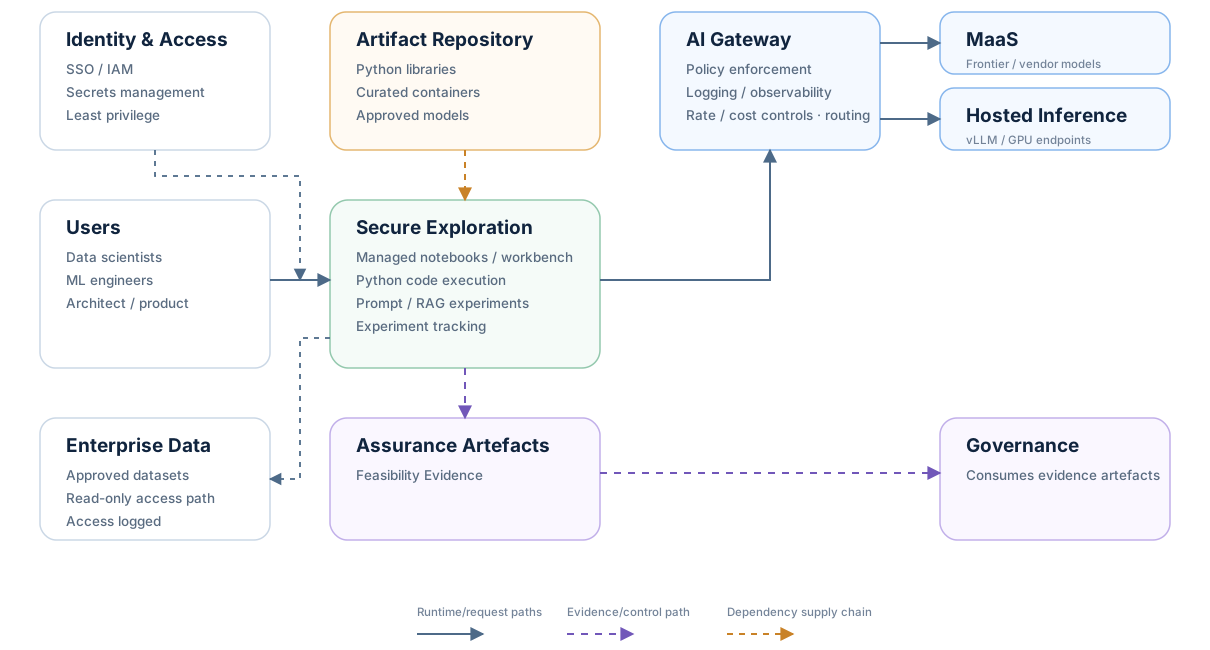
Secure exploration without weakening the production boundary.
A secure exploration environment gives data scientists and engineers access to enterprise data and AI models while keeping model access, dependencies, identity and evidence generation on controlled paths.
The exploration environment has no direct internet access. Model calls are mediated through an AI gateway; enterprise data is exposed through approved read-only paths; and Python dependencies are supplied through a staged, scanned repository.
Exploration produces feasibility evidence and architectural decisions — not production model assets. Production systems are subsequently rebuilt through controlled, reproducible release paths.